Steamed Breakfast Bao with Egg and Mushrooms
Soft steamed buns enclose a cooked egg, mushroom and spring onion filling. The dough rises before shaping, and the filled buns proof briefly before steaming in batches.

Rather eat it out? See restaurants near you that serve steamed breakfast bao.
📍 Find it near me ↗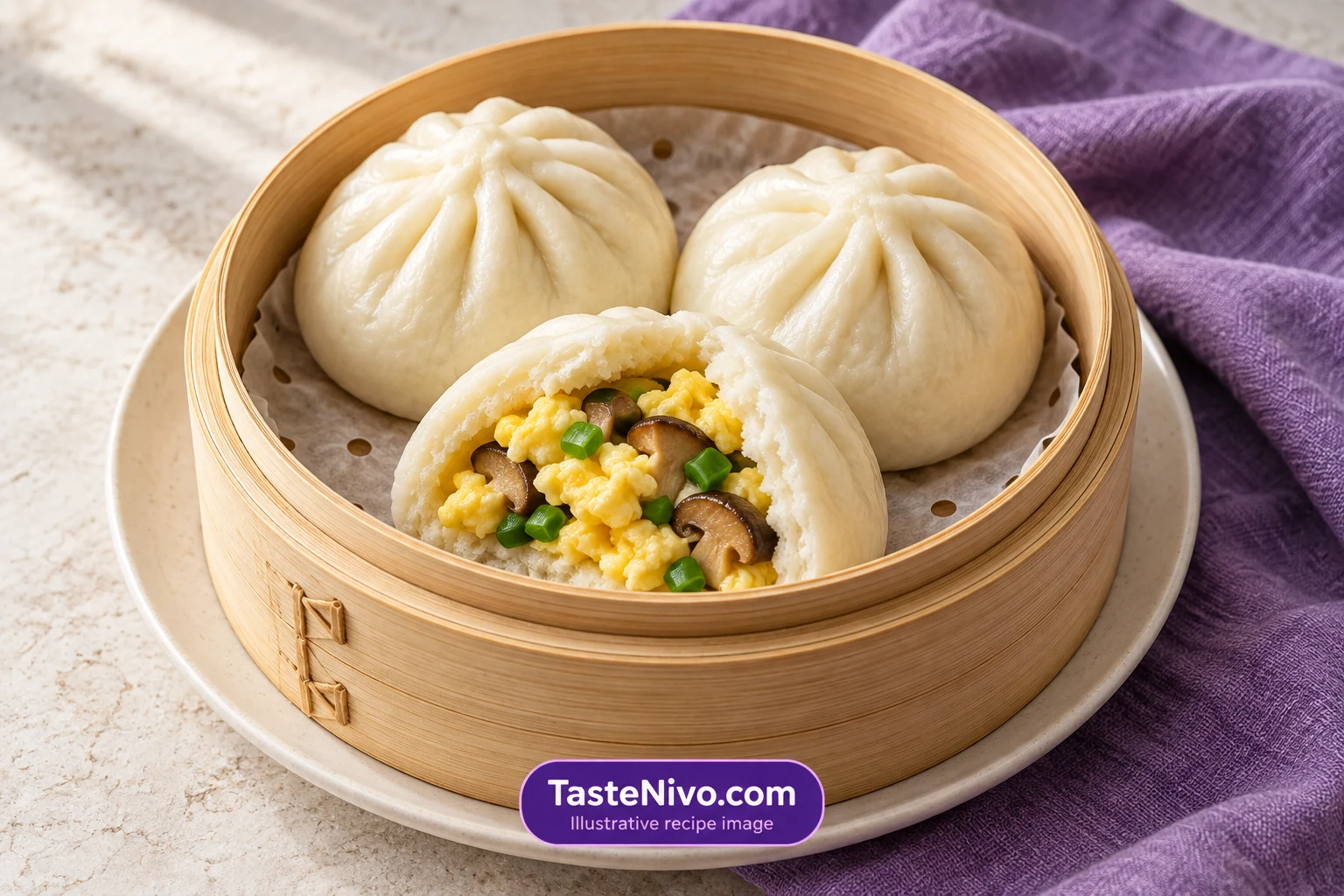
Steamed Breakfast Bao with Egg and Mushrooms
Ingredients
Equipment
Method
- Mix flour, yeast, sugar and salt. Add lukewarm water and canola oil, then knead for 8 to 10 minutes until smooth. Cover and let rise for about 60 minutes, until roughly doubled.
- Melt butter in a frying pan over medium heat. Cook mushrooms for 7 to 8 minutes until softened and fairly dry. Add beaten eggs and stir for 3 to 4 minutes until fully set, with no liquid egg. Stir in spring onions, soy sauce and sesame oil. Spread in a shallow dish and cool while the dough finishes rising; do not leave at room temperature longer than 2 hours.
- Divide dough into 8 equal pieces. Roll each into a 12 cm circle, keeping the centre slightly thicker than the edges. Divide filling equally among the circles, about 45 g each. Pleat and pinch the edges firmly together over the filling. Set each bun on a small square of baking paper.
- Place buns with at least 3 cm between them in steamer baskets, allowing room to expand. Cover and let proof for about 20 minutes, until slightly puffy. Prepare simmering water below the steamer; it must not touch the buns.
- Steam over steadily simmering water for 15 to 18 minutes per batch, keeping the lid closed. Check a bun centre reaches at least 74°C (165°F), and that the dough is set rather than sticky. Replenish water between batches and keep unsteamed buns covered; the stated time allows 2 batches.
- Turn off the heat and leave the lid on for 3 minutes before lifting it carefully away from the buns. Serve warm. The batch makes 8 buns, usually 2 per breakfast serving.
Notes
MAKE THE MEAL YOURS
Shopping & recipe cost
Shopping list & recipe cost
Planning for 8 buns.
Change yield with the recipe card controls ↑. This planner follows those controls. Quantities written in the method describe the original batch; adjust them too. Cooking time does not multiply.
Tick ingredients you already have to leave them off the shopping list. Ingredient costs still include them. Enter your own pack prices in CAD; no store prices are fetched.
Enter pack prices and amounts to estimate the ingredient cost.
Use the same unit and preparation for pack amount and amount used. For drained ingredients, use the usable drained pack amount. Changing between weight and volume requires your own measured quantity. Excludes energy, travel, taxes, sides and extra ingredients mentioned only in notes.
Prefer to eat out?
No menu-verified restaurant match is recorded for this recipe yet. Browse the restaurant guide.
Saved recipes & shopping list → Meals with shared ingredients →
Recipe by TasteNivo. See our editorial method for recipe preparation and illustrative image notes.
KEEP EXPLORING
Eggs and breakfast bakes
Browse the Breakfast & Brunch collection, or try:
For checking a yeast dough that has not expanded, see Bread dough not rising.