A useful utensil matches a repeated movement: folding batter, turning a pancake, stirring a sauce or lifting food from liquid. Material matters, but shape, stiffness, handle length and the cooking vessel matter just as much.
Begin with the pans and bowls you already own. This guide focuses on everyday mixing and serving utensils and their practical roles, without ranking products or treating a large matching set as an automatic improvement.
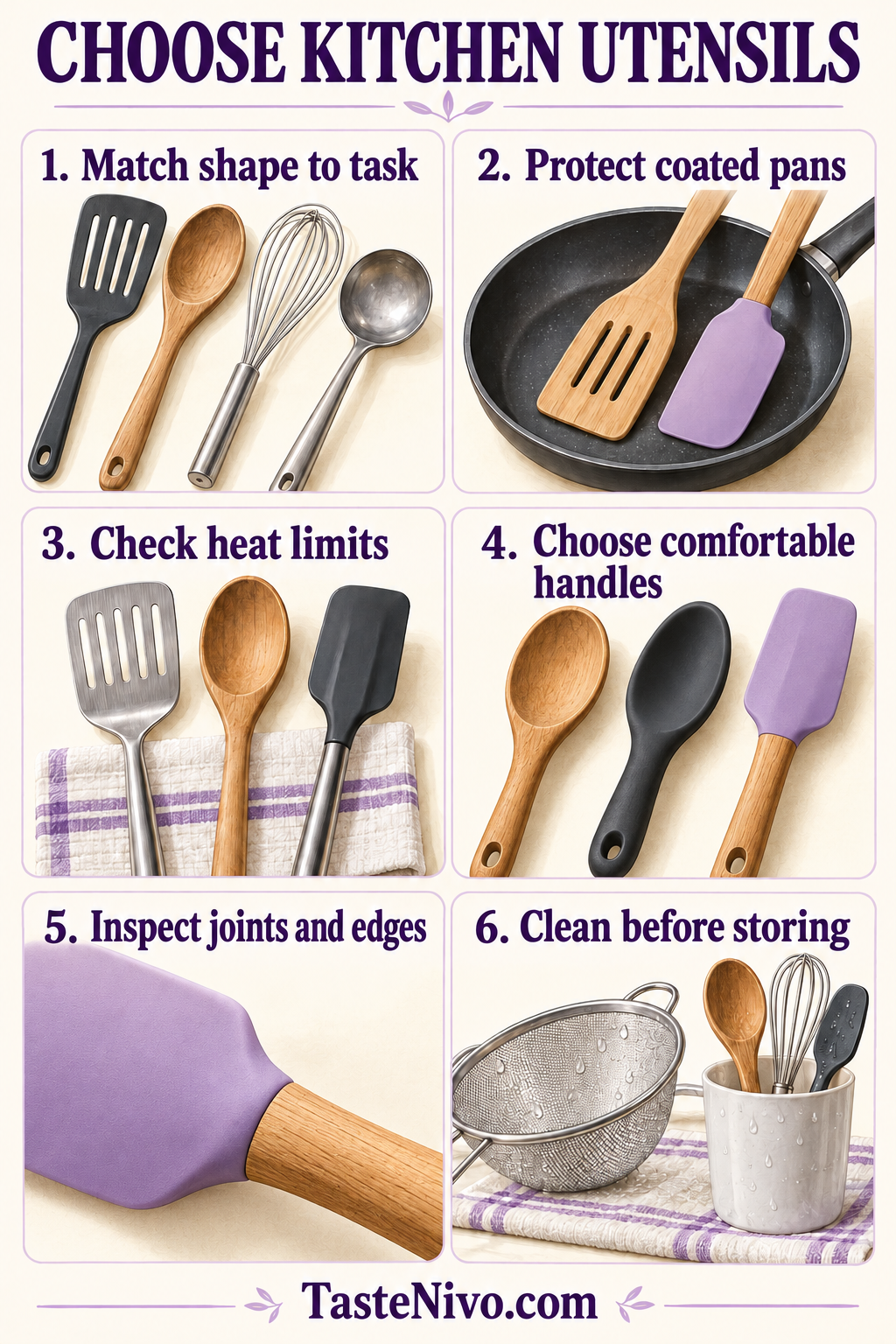
1. Name the movement before choosing the tool
Folding, scraping, stirring, turning, whisking and lifting are different actions. A utensil that performs one well may be awkward for another.
For folding batter, a flexible head that follows the bowl can be useful. For turning a pancake, a supportive flat shape matters. For stirring a dense mixture, excessive flexibility may make the task frustrating.
Watch the movement you repeat in a familiar recipe. Notice whether the tool reaches the base, follows the corners and supports the food.
A precise description of the problem leads to a better choice than the general idea that the kitchen needs more utensils.
2. Match the contact material to the vessel
Read the cookware manufacturer’s utensil instructions. A material permitted on one surface should not automatically be used in the same way on another.
Silicone, wood, nylon and metal have different characteristics and product-specific restrictions. Do not use a material name as a complete heat or compatibility rating.
A soft-looking utensil may contain joins, coatings or a handle with separate limits. Check the whole product.
Le Creuset’s care guidance is an example of a manufacturer resource that gives instructions for its surfaces and silicone tools. Use the exact product guidance rather than transferring one range’s figures to every utensil.
3. Compare flexibility and support
A flexible spatula can follow a bowl closely, but it still needs enough structure for the mixture. A very soft head may bend away from a heavy batter.
A turner should support the portion you intend to lift. Too little support can make delicate food fold or fall away during transfer.
A stirring spoon needs a shape that moves the mixture effectively without demanding excessive force. Check how it contacts the base and sides.
Assess flexibility as a match to the task, not as a quality score. The most flexible utensil is not necessarily the most useful one.
4. Look at head shape and reach
A rounded bowl and a pot with lower corners need different contact shapes. A spatula that follows one vessel well may leave a persistent unmixed band in another.
For a narrow jar, a smaller head can reach more effectively than a broad mixing spatula. For a large bowl, the same small head may make scraping unnecessarily slow.
A shallow spoon and a deep serving spoon hold and move liquid differently. Slotted designs drain some liquid, while solid designs retain it.
Choose dimensions that match the food and vessel. A utensil photographed alone does not show whether it fits your pan or reaches the bottom of your usual mixing bowl.
5. Check handle comfort and leverage
Handle length affects reach and the amount of space needed beside the hob. A long utensil may work in a deep pot but feel awkward in a small bowl.
Check whether the grip remains comfortable during repeated movement. Hard corners, a slippery finish or a bulky shape can matter more during use than in a quick shop comparison.
A hanging loop can help storage, but it should not create an awkward end that catches on nearby items. Consider the entire handle.
For a heavy mixture, leverage and stiffness work together. A long flexible utensil is not automatically easier simply because it keeps the hand farther from the bowl.
6. Read heat instructions and resting guidance
A stated heat limit applies to the specific product and its conditions. It is not permission to leave the utensil against any hot surface indefinitely.
Handles and removable components can differ from the working head. Follow the maker’s instructions for stovetop use, oven exposure and any contact restrictions.
A utensil rest can keep the working area organised, but choose one that suits the tool and counter. Do not balance a utensil where it can fall or leave its handle resting against a hot part of the setup.
Check cooking sprays, oils and ingredients against the product’s care instructions where relevant. Heat compatibility is one part of appropriate use.
7. Inspect joints and cleaning access
A one-piece design can reduce some joins, while a removable head can allow access if it is intended to come apart. Neither description alone tells you how easy the tool is to clean.
Look at the point where head and handle meet, and at any hollow or enclosed areas. Follow the approved disassembly and washing method.
Do not force a fixed head off because another product in a similar style is removable. Confirm the exact construction.
Dry as directed before storage or reassembly. A tidy utensil pot should not conceal tools that remain wet or have residue in hard-to-see areas.
8. Plan a small complementary collection
Start with the utensils used by the recipes you make often. A flexible mixing spatula, a supportive turner, a stirring spoon, a suitable whisk and a lifting tool may cover distinct tasks.
Do not assume every kitchen needs the same set. A cook who rarely makes a whisked mixture has different priorities from someone who bakes weekly.
Compare extra pieces by the task they add. Several almost identical spoons may contribute less than one head shape that reaches an awkward pot corner.
Check drawer or upright-container space. Tools should be easy to identify and remove without forcing their working heads against unsuitable objects.
Choose by the point of contact
For each recurring task, identify where the utensil needs to meet the food or vessel. A broad turner supports a portion; a flexible spatula follows a curve; a whisk needs room to move through a mixture.
Now inspect the tools already in the drawer. A familiar shape may perform poorly because it is too large for one bowl or too flexible for one mixture, not because the whole collection is low quality.
Choose a complementary tool that changes the relevant feature. A second spatula with the same head and stiffness may add less capability than a smaller head that reaches a narrow container.
Include cleaning and storage in that decision. A removable head can be convenient only when its approved disassembly and drying routine are manageable.
For heated tasks, check the exact tool’s restrictions together with the cookware surface. Do not let a matching colour scheme override incompatible use instructions.
After a familiar recipe, write a short observation about reach, support and grip. Keep the note specific: the head folded under dense batter, the handle was awkward in a small bowl, or the turner did not support the portion.
Those descriptions lead to a useful purchase without inventing a numerical ranking. They also reveal when a change in vessel or portion size would solve the problem more directly.
Avoid treating a full matching set as proof that the collection is complete. The relevant question is whether its shapes cover your actual movements.
A small group of clearly assigned utensils can make preparation more predictable than a crowded drawer of overlapping tools. Each should have a role, a compatible surface and a care routine you understand.
Compare the main roles
| Utensil | Useful movement | Important check |
|---|---|---|
| Flexible spatula | Folding and scraping | Head follows the bowl without collapsing |
| Turner | Supporting and lifting a portion | Width, support and pan compatibility |
| Stirring spoon | Moving a sauce or thicker mixture | Reach, stiffness and base contact |
| Whisk | Combining suitable mixtures | Bowl fit and comfortable movement |
| Slotted spoon | Lifting while allowing liquid to drain | Opening pattern and portion support |
| Serving spoon | Transferring a measured-looking portion | Depth, grip and receiving-vessel fit |
A worked example: folding pancake batter
Use a bowl with room to move and a spatula that reaches the base. Fold through the mixture until the recipe’s combining target is reached.
A tiny flexible head may leave dry pockets beneath a large batter. A very rigid tool can make it harder to follow the bowl’s curve.
Scrape the sides and base deliberately, then stop rather than continuing only to remove every small lump.
The utensil supports the method, but it does not decide how much mixing the batter needs. Follow the recipe’s texture cues.
A worked example: turning pancakes
Choose a turner that supports a useful portion of the pancake and fits beneath it in the pan. Side height and available space affect access.
Wait until the pancake has enough structure for the turn. A different utensil cannot fully compensate for trying to lift an unset mixture.
Use a controlled movement and avoid pressing the pancake flat afterwards if the recipe aims for a lighter texture.
Check the turner’s compatibility with the pan. Convenient support is not a reason to ignore the surface’s utensil restrictions.
A worked example: stirring a thick sauce
A utensil that reaches the base and lower corners helps distribute the mixture and reveal areas beginning to stick.
Choose enough stiffness to move the sauce without the head folding away. Match the material to the pot’s instructions.
Stir at the stage and frequency the recipe requires. Constant forceful movement is not an alternative to controlling excessive heat.
Inspect the tool after use and clean promptly through the approved method, especially around joins where thick sauce can remain.
A worked example: whisking in a small bowl
The whisk needs room to move, but a very large whisk in a small bowl can scatter ingredients and feel awkward.
Choose a shape that reaches the mixture and suits the intended action. A small quantity may need a different tool from a large batter.
Check whether the bowl’s surface permits the whisk material. The combination matters more than either item considered alone.
After combining, clean between the wires or elements as directed. A tool that is easy to use but hard to clean may not suit a frequent task.
A worked example: lifting vegetables from liquid
Choose a spoon or lifting utensil that supports the pieces while allowing the amount of liquid you want to drain.
Large openings can let small pieces slip through. A solid spoon retains more liquid. Neither is automatically the better option.
Set the receiving dish nearby and use manageable portions. An oversized load can be harder to control than several deliberate transfers.
If complete draining is required, a suitable strainer may be more practical than repeated spoonfuls. Choose the tool around the whole task.
Recognise when condition matters more than another shape
A utensil that has become damaged, distorted or loose at a joint should be assessed according to the maker’s guidance. Do not treat a deteriorating working surface as a normal inconvenience.
If a head no longer fits securely or a handle has changed shape, stop and check whether repair, part replacement or retirement is appropriate.
Buying another shape does not solve the condition of the original tool. Separate maintenance decisions from gaps in the collection.
Inspect the tools you already own before ordering a set. Some may remain useful for a different compatible task, while others should no longer be used.
Avoid judging only by a matching finish
Colour can make a collection attractive, but it does not show stiffness, reach or heat compatibility. Compare the individual shapes and instructions.
A set may contain one excellent match and several pieces that do not suit your vessels. Count useful roles rather than components.
If buying individually, keep the care routines manageable. A mixed collection is practical when each tool has a clear job and its instructions are understood.
Do not claim a model is best merely because its material sounds premium. Without direct comparative evidence, describe features and intended uses rather than inventing a ranking.
Before first use
- Read material, heat and cleaning instructions.
- Check the utensil against the vessel it will contact.
- Choose a familiar recipe to assess reach and support.
- Use the intended movement rather than excessive force.
- Inspect joins after cleaning.
- Store where the working head remains in good condition.
Do I need several spatulas?
Possibly, if their sizes or stiffness solve different tasks. Several identical heads may add less value than one well-chosen complementary shape.
Is silicone suitable for every use?
No universal assumption should be made. Check the exact product and the vessel instructions.
Can a slotted spoon replace a colander?
For some small transfers it may be convenient. A full draining task may be better handled by a suitable colander and receiving setup.
Should a utensil be left in the pan?
Follow the product’s resting and heat instructions. A quoted temperature limit is not a universal statement about prolonged contact in every position.
Put the tool to work
How to Make Fluffy Pancakes explains the related cooking or preparation method.
Related equipment guides
Put this guide to use
Browse Breakfast & Brunch · Quick & Easy for recipes that use this equipment or related techniques. Useful examples to read alongside this guide: Almond Butter and Oat Breakfast Bars · Amaranth Porridge with Mango and Coconut · Apple and Hazelnut French Toast Bake. Check each recipe for its particular method and batch size.