A useful pot fits the batch, the burner and the way you stir, drain and serve. A capacity printed on a box describes how much a vessel holds under a stated measurement, not necessarily the comfortable working quantity for every recipe.
Begin with the foods you cook often. Rice, soup, pasta, a reduced sauce and a braise place different demands on height, width and lid fit. This guide helps you choose complementary pots without assuming that a large matching set is automatically the most practical answer.
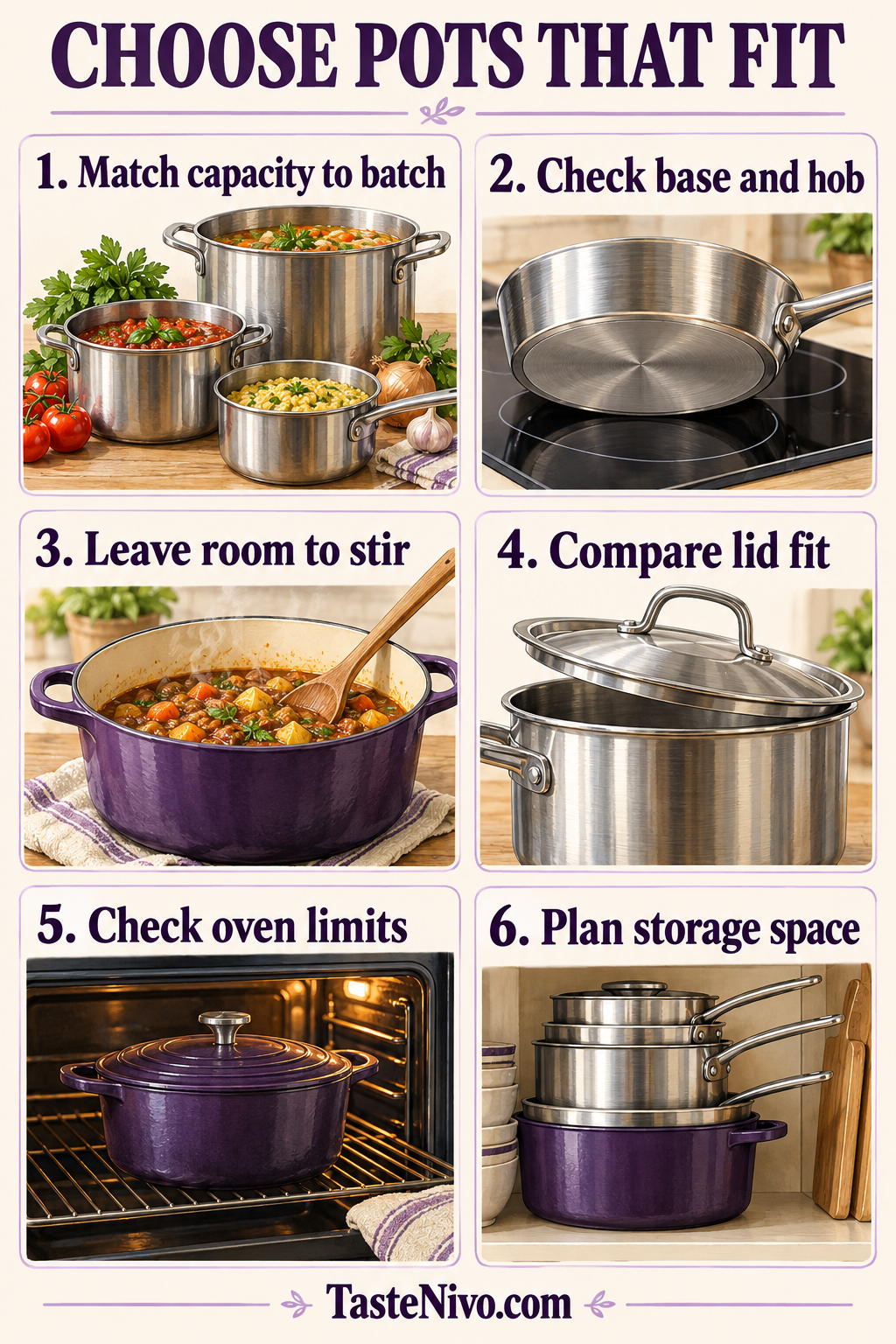
1. List the batches you actually cook
Write down the usual amount of rice, soup or sauce you prepare, along with the largest batch you make regularly. Separate frequent needs from the occasional meal that might be handled by another method.
A tiny pot can force a batch into several rounds. An oversized pot can also be inconvenient when a small quantity spreads into a very shallow layer. The right choice is not simply the maximum capacity available.
Account for stirring room and bubbling. A pot that holds a quantity of cold liquid close to its rim may not provide a useful working arrangement once ingredients and movement are involved.
Use a recipe’s suggested vessel as a starting reference. If you change the vessel substantially, expect evaporation and the shape of the food layer to change too.
2. Compare width and height together
A wide pot exposes more liquid surface, which can be useful for reduction. A tall narrow pot contains a deep batch differently and may suit other tasks.
For rice, base width, depth and lid fit all influence the cooking environment. For a sauce that should reduce, a very narrow pot may require more time than a wider vessel with the same stated capacity.
A deep pot can make stirring the lower corners less comfortable. Check whether your spoon reaches effectively without an awkward wrist angle.
Think about serving as well as cooking. A large heavy pot may be manageable on the hob but difficult to lift, tilt or position above a serving dish when full.
3. Match the base to the hob
Confirm compatibility for the exact pot. Induction suitability depends on the construction and base, not merely on whether part of the product is described as metal.
Read the hob’s cookware guidance, including size and placement requirements. A broad pot sitting over a small active area may heat differently from a well-matched vessel.
Inspect stability and base condition. A pot that rocks on a flat surface or has a damaged base deserves attention before use.
Do not assume every pot in a mixed set behaves identically. A small saucepan and a large stockpot can have different proportions and useful heating patterns even when their finishes match.
4. Consider the base and wall construction
A substantial base can moderate direct burner effects, but construction needs to be assessed as a whole. Thickness, layering and the way the base joins the walls influence the finished vessel.
A pot intended for long simmering may behave differently from one used for a quick small sauce. For a mixture that thickens or sticks readily, access to the base and controlled heat are particularly important.
Do not treat a visible disc or a marketing term as a complete performance explanation. Look for the manufacturer’s description and intended applications.
Weight is also an ownership consideration. A thick, heavy pot may suit some cooking methods while making draining and washing more awkward. Evaluate the full vessel rather than considering its empty mass in isolation.
5. Check the lid as a working component
A close-fitting lid helps maintain the environment expected by covered methods. A loose or mismatched lid changes steam loss and may make a recipe’s liquid quantity less predictable.
Look at how the lid sits and whether it can be handled comfortably with suitable protection. A knob’s shape matters when lifting it deliberately rather than merely touching it on a shop display.
Glass can make observation easier, but the view may be affected by condensation. Metal lids have their own handling and storage characteristics. Neither material removes the need to read the component’s use limits.
A vented lid and a close unvented lid are not interchangeable for every method. Follow the pot and recipe instructions instead of sealing or modifying a lid to force a different result.
6. Inspect handles, pouring and draining
Two side handles can make a large vessel easier to lift with both hands. A long saucepan handle gives a different grip and requires room beside other cookware.
Check handle placement and the clear space for oven mitts or another appropriate grip. A tiny loop can be awkward when the pot is full even if it appears neat in storage.
Pouring lips and straining lids may be useful, but assess how they actually align. A spout is not automatically a replacement for a colander, and a lid must be used only as the manufacturer intends.
Consider the route from hob to sink. A large pot can fit on the burner while being impractical to manoeuvre around the kitchen or wash in a small basin.
7. Read oven and cleaning instructions before purchase
A stovetop pot may have oven limits that depend on handles and lids. The assembled setup must respect the restrictions of every component.
Ordinary oven suitability does not establish grill or broiler suitability. Check the exact product document rather than borrowing a rating from a similar-looking range.
Cleaning requirements can influence whether a pot suits your routine. Dishwasher compatibility, recommended cleaners and surface maintenance vary by construction.
Manufacturer care guidance, such as All-Clad’s resources for its different cookware types, illustrates why the exact product matters. General advice about stainless steel or non-stick cannot replace component-specific instructions.
8. Plan storage without damaging the surfaces
Measure cupboard height, shelf depth and the overall span of handles. A tall stockpot may fit only after a shelf is moved, while several shallow pots can occupy more footprint than expected.
If nesting is permitted, protect surfaces as directed and avoid forcing lids or handles into contact with delicate finishes. A stack that is difficult to lift apart can discourage use.
Store lids so that they can be matched quickly. Several nearly identical lids create a practical problem if a covered recipe depends on the correct fit.
Do not buy a set whose pieces must be rearranged extensively every time one pot is needed. Accessibility is part of a useful kitchen collection.
Map a three-pot collection before buying a set
Imagine a kitchen that needs a modest rice batch, a regular soup and a sauce that sometimes reduces. These tasks do not necessarily require three pots with similar proportions.
A fitted small pot might serve the repeatable rice method. A manageable larger vessel could cover the soup, while a broader saucepan might make the reduction stage more convenient.
Now compare a proposed set with those roles. Count how many pieces actually fill a gap and how many duplicate a vessel that already works. Keep lids separate from the number of cooking vessels.
Check whether the chosen pots can be used together on your hob. Handles and wide bases can conflict even when each item fits individually. A collection that requires using only one piece at a time may not support the meal you planned.
Consider the cleaning route for the largest vessel. It should fit not just the burner but also the sink, drying area and storage shelf. Include the lid and any intended draining arrangement.
The same exercise helps with replacement. If the soup pot has become awkward to lift, buying a larger version because it appears more versatile moves away from the actual problem.
Record the working quantities that suit each vessel after use. That practical capacity is more useful to your recipes than remembering only the maximum volume printed on the packaging.
Keep the exact care documents with those notes. A matching exterior can conceal different construction or component restrictions, particularly when pieces are collected over time rather than purchased together.
A useful collection is the one whose roles remain clear during an ordinary meal. The goal is fewer awkward transfers and better control of the familiar recipes, not the largest possible number of matching components.
Compare pot shapes by task
| Shape | Useful applications | Question to ask |
|---|---|---|
| Compact saucepan | Small sauces and modest batches | Is there enough room to stir without overfilling? |
| Wide shallow pot | Reduction and broad ingredient layers | Does it fit the active hob area? |
| Tall stockpot | Larger liquid-based batches | Can I lift, drain and wash it comfortably? |
| Broad covered casserole | Methods that use a lid and may finish in the oven | Do body, handles and lid share suitable limits? |
| Small lidded pot | A repeatable rice or grain method | Does the lid fit and the batch depth suit the recipe? |
A worked example: rice for a regular dinner
Choose a pot that gives your normal rice quantity a manageable depth and has a suitable fitted lid. Keep that vessel consistent while learning the method.
A much wider replacement can change evaporation, while a deeper batch in a small pot can change how the top and bottom behave. Capacity alone does not capture those differences.
Check how low your burner can maintain a gentle simmer in the pot. A heavy vessel and a strong burner may need adjustment before the base dries.
If the current pot works reliably, record its shape and usual batch before buying another. The best replacement may be the one that preserves that useful setup rather than offering a dramatic increase in size.
A worked example: soup that will be blended
Allow room for the vegetables, liquid and stirring before considering blending. An overfilled pot makes both cooking and later handling less practical.
If using an immersion blender, check whether the pot’s depth and shape accommodate the blender’s required immersion and movement. Protect the pot surface according to both manufacturers’ instructions.
If transferring to a jug blender, follow that appliance’s instructions for hot mixtures and batch size. A large soup pot does not mean the entire batch belongs in the blender at once.
Choose a pot with handles that make the required transfer manageable. Consider ladling in stages rather than treating pouring as the only possible workflow.
A worked example: reducing a sauce
A broad surface can help evaporation, but it also changes how quickly the sauce tightens near the end. Select a pot that lets you reach the base and corners with an appropriate utensil.
A very small quantity in a very wide vessel may reduce faster than the recipe’s timetable suggests. Watch the sauce rather than assuming more surface area is always an improvement.
If delicate ingredients should not endure extended reduction, prepare the sauce stage separately as the recipe directs. Pot choice supports the method; it cannot prevent overcooking a component left in too long.
Taste as the liquid concentrates. A better-fitting vessel makes the process easier to manage but does not remove the flavour changes caused by reduction.
A worked example: draining a larger pasta batch
Check the pot, the quantity of cooking water and the draining arrangement together. A pot chosen without regard to the colander and sink can create a difficult final step.
Set the receiving colander or other approved draining setup before the pasta finishes. Confirm that it has enough capacity and sits as intended.
Consider lifting weight. A very large pot of water is a different load from the empty pot you handled in a shop. A smaller batch or staged transfer may be more practical.
Do not assume an integrated straining lid is suitable for every quantity or ingredient. Follow the manufacturer’s method and make the setup part of the purchase decision.
Avoid paying for overlap you do not use
Lay out the roles of your existing pots. If two vessels already handle small sauces well, another similar saucepan may add little.
Identify a real gap: a lid that fits, a wider base for reduction, a pot that works on a new hob, or a manageable capacity for regular soup.
Compare individual pieces with a set by useful roles, not by the number of components. Lids can contribute to a set’s count without adding another cooking vessel.
Leave room for the utensils and storage that make the pots usable. A collection that consumes every shelf can make everyday preparation slower.
Before the first cook
- Confirm hob compatibility and component limits.
- Wash or prepare the pot as its instructions require.
- Choose a familiar recipe with a suitable batch size.
- Observe the simmer and heat response before leaving it undisturbed.
- Note the lid fit and evaporation pattern.
- Clean with the recommended method and inspect the base afterwards.
Is one large pot enough?
It may cover occasional large tasks, but a small sauce or modest rice batch can be awkward in it. Choose from frequent uses rather than assuming capacity alone creates versatility.
Does a tight lid mean I can use less water in any recipe?
No. Follow a complete method written for the ingredient and vessel. Changing water independently can create a different cooking process.
Can I replace a lost lid with any similar diameter?
Check actual fit, venting, material and heat limits. A nominally matching diameter does not establish that the assembled setup behaves as intended.
What information is most useful to keep?
Retain the exact model’s care document, capacity and dimensions. Add a note about the recipes and batches that work well, so future replacements are based on the setup you actually use.
Put the tool to work
How to Cook White Rice explains the related cooking or preparation method.
Related equipment guides
Put this guide to use
Browse Chicken & Poultry · Meat Recipes · Soups & Salads for recipes that use this equipment or related techniques. Useful examples to read alongside this guide: Adzuki Bean and Pumpkin Soup · Adzuki Bean and Savoy Cabbage Soup · Amaranth and Yellow Pepper Soup. Check each recipe for its particular method and batch size.